I am having my first Black Friday Sale on my Etsy site! All my Felt Items (except the custom made coats) are up for at least 25% off, and for a very limited time I have posted my KNIT SAMPLES from this blog, up for the cost of the yarn only!
Here is your chance to love the items, and just buy it already finished.
So please pop over using THIS LINK, or the photo of the butterfly coat in the upper right corner. Contact me there if you have further questions.
Original patterns, comments and works in progress, all from Chris' knitted world.
Friday, November 25, 2016
Thursday, November 10, 2016
Quick and Easy Shawl
The beauty of this one lies in the long stripes that this yarn produces. The start of the shawl has the stripes close together and as you progress they get fatter and wider. Garter stitch makes this a beginner pattern!
Yarn: Lion Brand Scarfie. 2 balls of Denim / Navy. (or chunky equivalent 625 yards, or 560 meters)
Gauge: 12 - 14 sts = 4 inches in garter stitch on 6mm (US 10) needles. (not terribly important to hit this gauge)
Needles: 6mm or US 10, long circular needles (not knit in round, but best to hold that many stitches.
PATTERN:
Cast on loosely, 140 stitches.
Row 1: Knit 2 sts, knit 2 together, knit to end of row.
Row 2: Knit to end of row.
Repeat row 1 and 2 until you have one stitch left, and fasten off.
Wear it behind your back, or wrap it from the front for a huge lovely cowl!
Thursday, September 22, 2016
Sock Yarn Block Shawl (cowl)
Sock Shawl / Cowl
This pattern is NOT for beginners, but it is fun and
addictive, and you only work on 25 stitches at a time, building the blocks
together into a funky zig zag shawl or cowl.
There are many videos of Domino Knitting Squares, if you are
unfamiliar with the technique. You can
find one HERE or HERE.
Yarn: Self striping sock yarn (Kroy – grey brown marl) 4
skeins
Needles: 4mm (US 6) I
use circular needle for this, but straight needles are fine too
Gauge: approx 20 sts = 4 inches, AFTER BLOCKING. Its not too important that you match this, as it is a wrap-shawl-cowl. The one I made, after joining as a cowl is wrapped twice around my neck!
Finished length (after blocking) just under four feet. (and very stretchy)
***Follow the drawings of the blocks to make sure you are
sticking to the plan. I will use the
alphabet assignments in the photos for reference in the pattern
Block A: Cast on 49 sts. Row 1: Knit 25, place marker, Knit 24.
Row 2: Knit 22, knit 2 together, slip marker, knit one, knit 2 together, knit 22.
Row 3 (and all odd rows): Knit to stitch BEFORE marker, purl that stitch, slip
marker and knit the rest.
Row 4 (and all even rows) knit to
2 sts BEFORE marker, knit 2 together, slip marker, knit one, knit 2 together,
knit the rest. Repeat until only 3 sts remain and knit all three together.
(only one stitch on your needle.
Block B: With this stitch at upper right corner of square,
pick up 25 stitches across the top of the just worked square (place marker just
before last pick up). Cast on 24 more stitches. Now turn and work exactly like
the first square starting with row 1.
When reduced to one stitch, begin
the next square above the last. Continue to build squares C and D in the method
of block B. Bind off last stitch at the
end of block D, and break yarn.
Block E: Cast on 24 stitches, then pick up one stitch
right at the corner of block A and B (see chart photo), then pick up 24 more
evenly across the upper part of Block B.
Work the block as in A from row 1.
Block F: Pick up 25 across the left side of block E,
(make sure the 25th stitch is right in the corner of where B and C
meet) and then pick up 24 more across the top of block C. Work as usual.
Block G: like block F.
Block H: Pick up 25 on the left
side of G, then CAST ON 24 more (this part is not attached to any other
side). Work the block as usual (see the
photos in the chart to see where this block is placed).
Block I: like
E.
Block J and K: Like F
Block L: Like H
Block M: Like E
Block N and O: Like F
Block P: Like H
Gently wash and block flat.
This is now a zig zag shoulder
wrap or shawl. Wear it like that….. OR……
COWL VERSION: carefully turn it into a TUBE, matching the
bottom edge of A with the top edge of N (place pins on these squares before you
make the tube so you can see how this lines up.
It’s a diagonal seam , sewing A tyo N, and B to O, and C to P. Sew this seam with Kitchener stitch (and not
too tightly).
Sunday, April 24, 2016
Sock Yarn Shawl
My wonderful new friends at YarnCanada.ca have sent me some of my favourite sock yarn to play with, and I have decided to create a new shawl pattern with this yarn.
I will create a design the shows off the thick stripes of this particular colourway, the Grey Brown Marl Kroy, and will post the pattern on a future entry. Meanwhile if you would like easy access to a great mail order site, please pop over to www.yarncanada.ca, and pick up four balls of Kroy for this shawl project, or two balls of Kroy for my most knit pattern: The Best Sock Pattern Ever!
Here is another photo of The best sock pattern ever, featuring an old colourway of Kroy Sock Yarn. Kroy yarn has been my "go to" yarn for socks, as it is durable, washable and stands up to many years of wear, and it has great colours every year. This pattern fits well and even beginners seem to "get" the heel turn (sometimes with a little local yarn shop help).
See you in a couple of weeks with the finished shawl! Happy knitting.
I will create a design the shows off the thick stripes of this particular colourway, the Grey Brown Marl Kroy, and will post the pattern on a future entry. Meanwhile if you would like easy access to a great mail order site, please pop over to www.yarncanada.ca, and pick up four balls of Kroy for this shawl project, or two balls of Kroy for my most knit pattern: The Best Sock Pattern Ever!
Here is another photo of The best sock pattern ever, featuring an old colourway of Kroy Sock Yarn. Kroy yarn has been my "go to" yarn for socks, as it is durable, washable and stands up to many years of wear, and it has great colours every year. This pattern fits well and even beginners seem to "get" the heel turn (sometimes with a little local yarn shop help).
See you in a couple of weeks with the finished shawl! Happy knitting.
Monday, January 18, 2016
Sewing Tip. Keep your Fluevogs young and beautiful!
I just received my newest booties. They are Sugars from my favourite Canadian shoe designer John Fluevog. If you have not spent time on his website, prepare to be captivated by beautiful, creative and stunning footwear!
As I did with my Luna boots, I made a boot support out of the cool boot bag that they sent along with the lovelies.... First a photo of the wonderful boots!
Next the bag with pins where the "legs" will be.
Sew the new seam.
Then turn it (clip the curve first) and throw some light stuffing into the "legs".
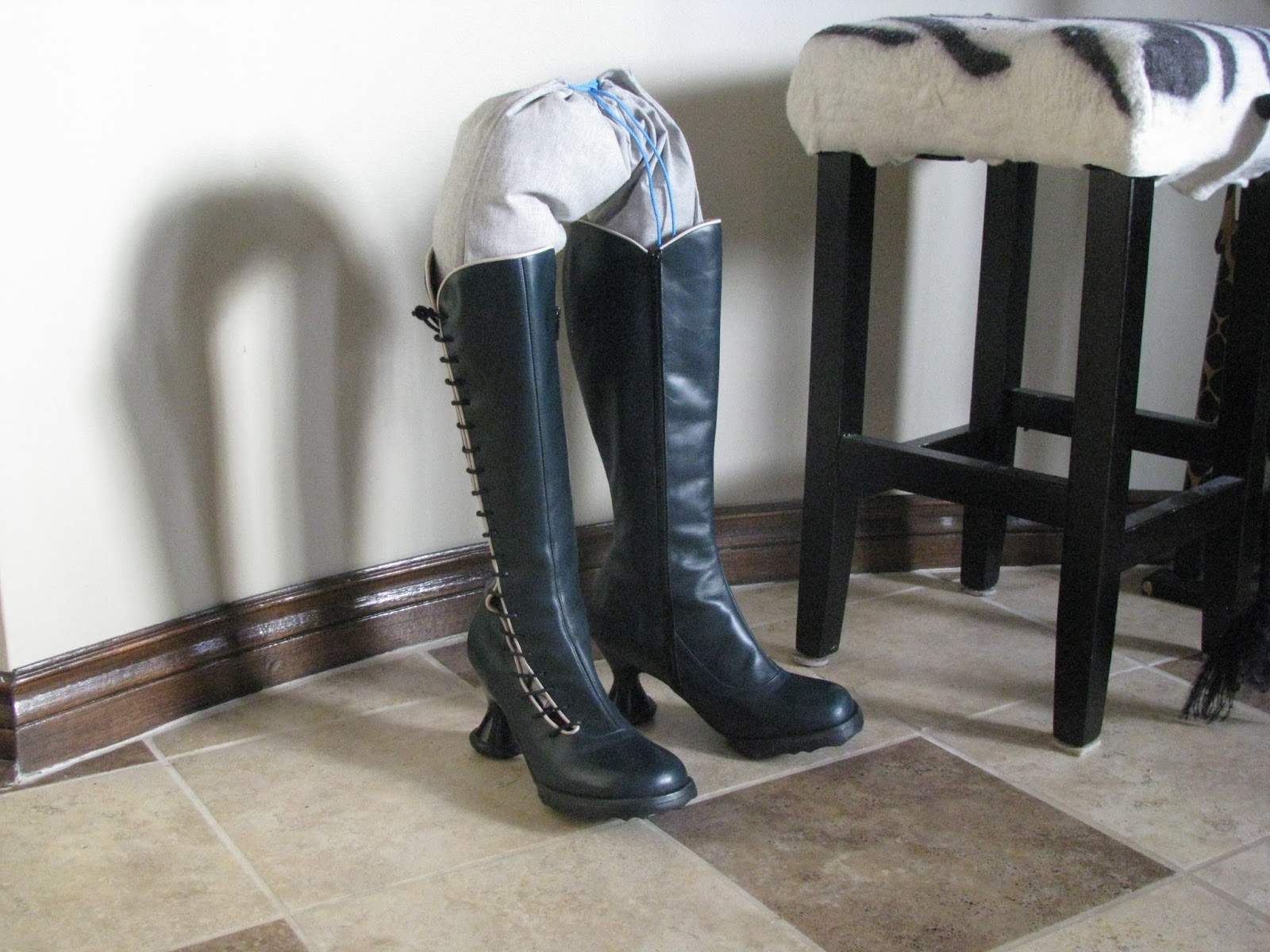
Now insert into boots, I even zipped them in for a sturdy fit, and you can see them standing proudly in my hallway, waiting to be let outside! This preserves the leather from getting creases due to fold over or collapse in your closet. Take good care of your Fluevogs, and they will compliment you forever.
As I did with my Luna boots, I made a boot support out of the cool boot bag that they sent along with the lovelies.... First a photo of the wonderful boots!
Next the bag with pins where the "legs" will be.
Sew the new seam.
Then turn it (clip the curve first) and throw some light stuffing into the "legs".
Now insert into boots, I even zipped them in for a sturdy fit, and you can see them standing proudly in my hallway, waiting to be let outside! This preserves the leather from getting creases due to fold over or collapse in your closet. Take good care of your Fluevogs, and they will compliment you forever.
Thursday, November 12, 2015
Emmett's Sweater Vest
This pattern is for a baby "grandpa vest", and is sized to fit 3 - 6 months, 9 - 12 months, and 18 months. It could be perfect to use up some leftover DK weight. Please use the swatch / gauge test to assure a perfect baby fit!
Sizes: Small (3-6 months), Med (9-12 months), large (18
months)
Yarn: 150 grams of
light worsted weight (DK weight or Sport weight) *** check recommended needles
and estimated gauge. Work a swatch and
recheck gauge after washing!!!
Gauge : 17 sts = 4
inches after washing.
Needles: 4mm for
body, 3.75mm for ribbing , 3.75mm
circular for bands.
4 buttons, ¾ - 1 inch
Back
With 3.75mm needles, cast on 37 [39 ,43] sts
Establish rib pat on Row 1: *K1 , P1.
Repeat from *. End K1.
Row 2: P1, K1 across, ending with P1.
Work 5 rows. On row 6, increase 5 [6, 6] sts across the
row. 42 [45, 49] now on needles.
With 4.0mm needles, work in stocking stitch until piece measures
5 [6, 6.5] inches.
Underarm Shaping: Bind
off 4 sts at beg of next 2 rws.
Continue in stocking stitch until piece measures 9" [1.5, 11.5] inches.
Bind off all stitches.
Front Left Side:
With smaller needles, cast on 19 [20, 22] sts.
Work rib pattern for 5 rws [1"]. On row 6, inc 2 sts across
the row. 21 [ 22, 24] stitches now on
the needle.
Change to 4.0mm needles, and work in Stocking Stitch until
5[6,6.5] inches are worked.
With right side facing: bind off 4 stitches for the armhole
edge. Then start the neck shaping like
this: at the end of the armhole shaping row, knit the LAST two stitches together. Continue in Stocking Stitch, decreasing at
the last 2 stitches on every right side row only (every 2nd row)
until 9[10,11] stitches are left. Continue without decreasing until total
length is 9[10.5, 11.5] inches. Bind off
all stitches.
Front Right Side:
With smaller needles, cast on 19 [20, 22] sts.
Work rib pattern for 5 rws [1"]. On row 6, inc 2 sts across
the row. 21 [ 22, 24] stitches now on
the needle.
Change to 4.0mm needles, and work in Stocking Stitch until
5[6,6.5] inches are worked.
With wrong side facing: bind off 4 stitches for the armhole
edge. Purl to end of this row. Then
start the neck shaping like this: on the NEXT row: knit the first two stitches together. Continue in Stocking Stitch, decreasing at
the frist 2 stitches on every right side row only (every 2nd row)
until 9[10,11] stitches are left. Continue without decreasing until total
length is 9[10.5, 11.5] inches. Bind off
all stitches.
Weave in all ends.
Seam each shoulder.
Armhole Edging:
With 3.75mm needles, pick up 38 [42, 46] stitches around
armhole edge. Work in 1 by 1 ribbing for three rows, cast off loosely in
ribbing on fourth row.
Finishing Band:
With 3.75 long circular needle and
RS facing, begin at lower right front
edge. Pick up 20 [24, 28] stitches to first neck dec, pick
up 17 [17, 18] sts along theangled neck
edge, pick up 18 [18, 20]sts along the back of the neck, pick up 17 [17, 18] sts
down along the angled neck edge, pick up 20 [24, 28] sts to the end of the left
side. Work one row in 1 by 1 ribbing.
Next row: (button hole row- you will make four button holes) …. keeping in the ribbing pattern: Work 2 [3, 4] stitches, Yarn over, knit 2
together, work 4 [5, 6] stitches, Yarn
over, knit 2 together , work 4 [5, 6] Yarn over, knit 2 together, work 4 [5, 6]
stitches, Yarn over, knit 2 together. Work the rest of the row in ribbing.
Next row, work ribbing, working the yarn overs back into the
ribbing pattern.
Work one more row of ribbing, then cast off next row in rib
stitch (loosely).
Weave in ends, and sew side seam. Sew buttons opposite holes.
Pockets: (optional)
With 4mm needles,
Cast on 11 [11, 13]
stitches. Work in stocking stitch for 2
[2, 2.5] inches. Change to 3.75 mm
needles and 1 by 1 ribbing, rib for 1 inch and cast off loosely all stitches.
Sew pockets as shown in photo.
Close up (sorry it's blurry) of the buttons and pocket.
Friday, September 11, 2015
Denim Blanket Coat
Denim
Blanket Coat
This loose
fitting blanket style coat is my first pattern involving STEEKS. I (probably like you) was afraid of steeks,
what with all the cut ends to finish off somehow. It seemed like it would all unravel as I
attempted to negotiate those cut rows!
This time though, the unraveled ends seemed perfect for the blanket
fringe I had in mind, so I gave it a go.
I love the results, and although it was a bit of work to make the
fringe, I did it in a way that was totally manageable, and will try to walk you
through in words and photos.
This is NOT
a beginner pattern.
Yarn: DK
weight that knits to gauge**** please knit a swatch and block and measure! Approximately 500 grams or 1200 yards. (I used a mill end cone of merino tape, so
exact yarn will not be available)
Needles: 24”
circular needles, 4mm or whatever hits the gauge.
2 stitch markers. Long stitch holder or spare circular needle
to hold stitches not being used.
Fringe twister (optional, you could hand braid the fringe)
Gauge: 17 stitches = 4 inches in stocking stitch
(after blocking) on 4mm needles. I knit
loosely so you may need 4.5 or 5mm to get my gauge.
Sizes: Small (fits 32-36”bust),[ Med/Large (fits 38 –
42”), XL (fits 44 – 48”)]
The body of
this coat is worked in the round until armholes, then the back and front are
worked separately. “Steeks” are then cut
and unraveled to create a front opening, and a fringe.
Body: With circular needles, cast on 12, place
marker, cast on 170[188,210], place marker, cast on 12. Carefully join without twisting, and begin
pattern:
Knit 12,
slip marker, seed stitch 170[188,210], slip marker, knit 12.
Repeat this
row until 1.5 inches of seed stitch are done.
Change to
body pattern: Row 1, 2, and 3, knit
every stitch.
Row 4, 5,
and 6: knit the 24 steeks stitches (the short section between the markers) and
purl the 170[188,210] body section stitches.
Repeat rows
1 through 6 for the horizontal rib pattern.
Work until
length from the beginning is 17”[18”, 19”], or length you want to the underarm.
Divide your
front from the back like this:
Beginning at first marker (continuing the ribbing pattern), work 45[50,56 ] cast off 6 stitches, work in pattern next 68[76, 86] stitches, cast off next 6 stitches
*place last 68 [76,86 ] stitches on stitch holder or spare circular
needles. Work in pattern until last
stitch marker.
Now you will
work the ribbing pattern and maintaining
the steek (24 stitches between the markers) without joining the circular
needles ….
You are
working from underarm to underarm and the steek stitches are in the MIDDLE of
the front.
Continue
ribbing pattern and the steek stitches are now stocking stitch (knit the right
side, purl the wrong side) Until you
have 9[9, 10] inches from the underarm split.
Next row: Cast off loosely until first marker, remove marker and work to
end of row. Next row: cast off loosely
until last marker: You now have only the
24 stitches between the marker “live”. Do not cast these off! Place these on a stitch holder, and place
back stitches (from holder ) back on circular needle.
Work these
stitches in the ribbing pattern until you have 9[9,10] inches done. Cast off all stitches loosely.
Sleeves:
Cast on
34[38,42] stitches. Work in seed stitch
for 1.5 inches. Change to stocking
stitch and work for 3 inches, INCREASING one stitch each end every four
rows. At 3 inches, work three repeats of
the 6 horizontal ribbing pattern. Return
to stocking stitch for the rest of the sleeve.
Always increase every four rows until you have 76[78, 82] stitches, then
continue without increasing until you have 17 inches from the start (or length
you would like for the sleeve to the underarm).
Cast off 5
stitches at the start of next two rows.
Cast off 6
stitches at the start of next two rows.
Cast off 8
stitches at the start of next two rows.
Cast off all
the rest of the stitches.
Steek
Cutting: (photos below) carefully, find the center of
the 24 steek stitches, and cut between the stitches all the way down the
front. Do not unravel yet.
Starting at
one end. Pull out two threads and using
the fringe twister, create a twisted fringe and tie a knot to hold it. OR if you do not have a fringe too, you can
pull three threads and braid them to the end, tying a knot there to hold it.
Work all the
way down one side and up the other.
Watch that you do not pull too hard, you want the edge of the body to
lie nice and flat. Take your time. It will be beautiful when done. The cast on row can be a bit tricky but
unravel it too. Braid four strands at the
end if there is one left alone.
Once the
fringing is done, you can sew a 4 inch shoulder seam, starting at the armhole.
Sew your
sleeve seam.
Pin the
sleeve evenly into the armhole and sew in place.
Gently wash
and block your new coat!
Fringe twister tool:
Subscribe to:
Posts (Atom)